La Escuela Nacional De Arte Y La Plãƒâ¡stica Cubana Contemporãƒâ¡nea
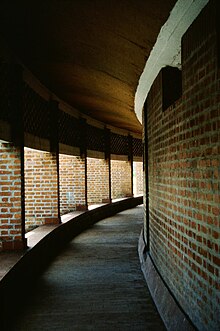
Coordinates: 23°05′17″N 82°26′53″West / 23.08806°Due north 82.44806°Due west / 23.08806; -82.44806 The National Art Schools (Escuelas Nacionales de Arte) of Cuba is one of the nearly important educational institutions of the Cuban nation and has been declared as "National Monument".
Cuba'due south National Art Schools (Escuelas Nacionales de Arte, now known as the Instituto Superior de Arte) are considered by historians to be among the most outstanding architectural achievements of the Cuban Revolution.[1]
These innovative, organic Catalan-vaulted brick and terra-cotta structures were built on the site of a former country lodge in the far western Havana suburb of Cubanacán, which was once considered to exist Havana'southward "Beverly Hills", and was and so mainly reserved for Communist Party officials.[ii] The schools were conceived and founded past Fidel Castro and Che Guevara in 1961, and they reflect the utopian optimism and revolutionary exuberance of the early years of the Cuban Revolution.[3] Over their years of active apply, the schools served as the principal incubator for Cuba's artists, musicians, actors and dancers.
By 1965, however, the art schools and their architects fell out of favor as Soviet-inspired functionalist forms became standard in Cuba. Additionally, the schools were subjected to accusations that their pattern was incompatible with the Cuban Revolution. These factors resulted in the schools' near-complete decommissioning and the deviation of two of their three architects. Never fully completed, the complex of buildings lay in various stages of use and abandonment, some parts literally overgrown by the jungle until preservation efforts began in the offset decade of the 21st century. The schools' legacy was somewhen brought to light by regional and international architectural journals in the 1980s, piquing the marvel of observers both internationally and within Cuba through the 1990s. This growing interest reached its apex in 1999 with the publication of the book Revolution of Forms - Cuba's Forgotten Fine art Schools, past John Loomis, a California-based architect, professor, and writer. Post-obit the publication of Revolution of Forms, the schools attracted even greater international attending and in 2000 they were nominated for the Earth Monuments Fund Watch Listing. In November 2010, the National Art Schools were officially recognized as national monuments past the Cuban Government,[4] and they are currently being considered for inclusion on the Globe Heritage list of sites which accept "outstanding universal value" to the world.[v]
Cuba'south National Art Schools accept inspired a series of art installations under the proper noun of Utopia Posible by the Cuban artist Felipe Dulzaides, the documentary motion-picture show Unfinished Spaces by Alysa Nahmias and Ben Murray, and an opera directed by Robert Wilson entitled Revolution of Forms (named afterward John Loomis' book)[6] written by Charles Koppleman.
Conceptualization [edit]
In January 1961, the Cuban revolutionary leaders Fidel Castro and Che Guevara, enjoyed a drink afterwards they finished a game of golf at Havana'due south formerly exclusive State Society Park, pondered the future of a country club whose members had all fled the country. The Cuban Literacy Campaign had just been launched, and with the inspiration of extending the program's success into a wider cultural loonshit, Guevara proposed the creation of a complex of tuition-free fine art schools to serve talented young people from all over the Tertiary World. He conceived of the schools every bit highly experimental and conceptually avant-garde to serve the creation of a "new civilisation" for the "new man". An innovative program called for innovative compages, and Castro saw the Cuban builder Ricardo Porro as being that builder who could deliver such architecture.[7]
Cuba'south National Art Schools represented an attempt to reinvent compages in the same way that the Cuban Revolution aspired to reinvent society. Through their designs, the architects sought to integrate problems of civilization, ethnicity, and place into a revolutionary formal limerick hitherto unknown in architecture.[8]
Design of the five schools [edit]
The design of the National Art Schools, created by Ricardo Porro, Roberto Gottardi, and Vittorio Garatti, ran counter to the dominant International Style of the fourth dimension. The three architects saw the International Fashion every bit the architecture of capitalism and sought to recreate a new architecture in the paradigm of the Cuban Revolution. These critiques of modernism existed in a broader context of critique and are considered to be notable additions to the spectrum of innovative architecture from the period. Architects such as Hugo Häring, Bruno Zevi, Ernesto Nathan Rogers, and Alvar Aalto, not to mention Frank Lloyd Wright, all practiced on the margins of mainstream modern compages. For Porro, Gottardi, and Garatti, this international response to modernism mixed with more region-specific expressions of Hispanic and Latin American identity (long later on Gaudí but sharing his Catalan influence) in the post-WWII earth.[9]
The architects fix their design studio on the site of the former country social club. They decided that there would be three guiding principles for the design of the fine art schools. The showtime principle was that the architecture for the schools would be integrated with the widely varied, unusual landscape of the golf game course. The second and third principles were derived from fabric necessity. The US embargo against Republic of cuba, begun in 1960, had fabricated the importation of rebar and Portland cement very costly. The architects therefore decided to apply locally produced brick and terracotta tile, and for the constructive organization they would use the Catalan vault with its potential for organic course. When Fidel Castro viewed the plans for the art schools, he praised their design, maxim that the complex would be "the nigh beautiful academy of arts in the whole world".[10] There were five art schools within the academy: the School of Modernistic Dance, the Schoolhouse of Plastic Arts, the Schoolhouse of Dramatic Arts, the School of Music, and the School of Ballet.
School of Modernistic Dance – Ricardo Porro [edit]
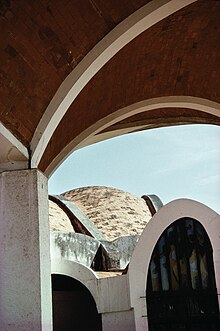
Porro conceived the modern trip the light fantastic toe school'due south plan as a sail of glass that had been violently smashed and fragmented into shifting shards, symbolic of the revolution's violent overthrow of the sometime order.[11] The fragments assemble around an entry plaza - the locus of the "touch on" - and develop into an urban scheme of linear, though not-rectilinear, shifting streets and courtyards. The entry arches form a hinge effectually which the library and administrative bar rotate abroad from the residue of the school. The south side of the fragmented plaza is defined by rotating trip the light fantastic pavilions, paired around shared dressing rooms. The north edge, facing a abrupt drop in terrain, is made past two linear bars, containing classrooms, that form an obtuse bending. At the culmination of the angular procession, farthest from the entry, where the plaza once again compresses is the celebrated form of the performance theater.
School of Plastic Arts – Ricardo Porro [edit]

The concept for this school is intended to evoke an archetypal African village, creating an organic urban circuitous of streets, buildings and open up spaces. The studios, oval in plan, are the bones prison cell of the complex. Each one was conceived as a small arena theater with a central skylight to serve students working from a live model. The studios are organized along ii arcs, both of which are curving colonnaded paths. Lecture rooms and offices are accommodated in a contrasting blocklike programme that is partially wrapped by and engaged with the colonnaded path. Ideas of gender and ethnicity converge in the curvilinear forms and spaces of Plastic Arts. Well-nigh notable is how the organic spatial experience of the curvilinear paseo archetectonico delightfully disorients the user not beingness able to fully see the extent of the magic realist journey beingness taken.[12]
School of Dramatic Arts – Roberto Gottardi [edit]
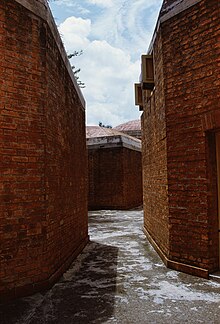
The School of Dramatic Arts is urban in concept, as are Porro'south ii schools. Dramatic Arts is organized as a very meaty, centric, cellular program effectually a central plaza amphitheater. Its inward-looking nature creates a closed fortress-similar exterior. The amphitheater, fronting the unbuilt theater at what at present is the entrance, is the focal point of all the subsidiary functions, which are grouped around it. Circulation takes identify in the narrow leftover interstices, open to the sky like streets, between the positive volumes of the masonry cells. Winding more or less concentrically through the complex, circulation negates the axiality and generalized symmetry that organize the programme. This presents an interesting contradiction betwixt the formal and the experiential. While quite ordered in plan, the experience of walking through the circuitous is random and episodic.[13]
School of Music - Vittorio Garatti [edit]
The School of Music is synthetic as a serpentine ribbon 330 meters long, embedded in and traversing the contours of the landscape approaching the river. The scheme and its paseo arquitectonico begin where a grouping of curved brick planters step up from the river. This path submerges below ground every bit the band is joined by another layer containing group practice rooms and another exterior passage, shifted upwardly in department from the original ring. Displacements are read in the roofs equally a series of stepped, or terraced, planters for flowers. This 15m wide tube, broken into two levels, is covered by undulating, layered Catalan vaults that emerge organically from the mural, traversing the contours of the ground aeroplane. Garatti's meandering paseo arquitectonico presents an ever-changing dissimilarity of lite and shadow, of dark subterranean and vivid tropical environments.[14]
School of Ballet – Vittorio Garatti [edit]

From the pinnacle of the golf class'due south ravine, ane looks down upon the ballet school complex, nestled into the descending gorge. The program of the school is articulated past a cluster of domed volumes, connected past an organic layering of Catalan vaults that follow a winding path. There are at to the lowest degree five means to enter the complex. The nigh dramatic entrance starts at the top of the ravine with a unproblematic path bisected by a notch to carry rainwater. Equally one proceeds, the terra cotta cupolas, articulating the major programmatic spaces, emerge floating over lush growth. The path then descends down into the winding subterranean passage that links the classrooms and showers, three dance pavilions, administration pavilions, library and the Pantheon-like space of the performance theater. The path also leads upward onto its roofs which are an integral part of Garatti's paseo arquitectonico. The essence of the pattern is not found in the plan only in the spatial feel of the schoolhouse'due south choreographed volumes that move with the descending ravine.[15]
Refuse [edit]
The 1962 Cuban Missile Crisis provoked an international incident that posed serious challenges for Cuba. In addition, setbacks beyond the Socialist world (the assassination of Congolese leader Patrice Lumumba in 1961, the coup against Algerian President Ahmed Ben Bella in 1965, the Sino-Soviet split, the newly launched guerrilla war in Vietnam), marked a turning signal and created a sense of isolation and embattlement in Cuba facing the Cold War solitary in the Caribbean area. Production and defense became main national priorities and the population was militarized. The regime began to consider the National Art Schools to be extravagant and out of scale with reality.[16] Construction of the fine art schools slowed down, as more than and more than of the workforce was now redirected to areas considered of greater national priority. The architects were also encountering criticism. Many in the Ministry building of Structure did not trust the Catalan vault as a structural arrangement. There was also a certain amount of envy on the part of many of the ministry bureaucrats toward the comparatively privileged weather condition nether which Porro, Gottardi, and Garrati were working.[17] These tensions would prove to escalate.
As Cuba's political environment evolved from one of utopian optimism into an evermore doctrinaire structure, following models provided past the Soviet Union, the National Art Schools found themselves every bit subjects of repudiation. The schools were criticized for ideological errors. The architects themselves were accused of being "elitists" and "cultural aristocrats," with "egocentric" bourgeois formations.[18] The effective system, the Catalan vault, was now criticized as a "primitive" technology that represented "backward" values of the backer by. The Afro-Cuban imagery of the School of Plastic Arts was attacked as representative of "hypothetical Afro-Cuban origins" which had been "erased by slavery" and therefore held no relevance of a social club advancing toward a culturally uniform socialist futurity.[xviii]
Soviet-style functionalism vs. organic architecture [edit]
At the same time, these ideological problems also served to mask a very non-ideological drama. The National Art Schools and their architects were caught in a ability struggle, with an architect named Antonio Quintana playing a major part. Quintana was a staunch modernist who, every bit the 1960s unfolded, embraced a Functionalist model for architecture, a model that advocated massive prefabricated production – precisely the model upon which architecture was based in the Soviet Matrimony. This model was completely at odds with the site-specific, craft-oriented, formal poetry of the National Art Schools. Quintana quite successfully, and quickly, maneuvered his way up through the ranks of the Ministry of Construction to ever increasing ability. His growing authority and outspoken criticism of the National Art Schools helped to determine their fate. In July 1965, the National Art Schools were declared finished in their various stages of completion and incompletion, and structure came to a halt.[xix]
In October 1965, Hugo Consuegra wrote a courageous defense of the National Art Schools, and their architects, that was published in the journal Arquitectura Cuba. This article was the final attempt of this period to reconcile the schools with the values of the Cuban Revolution. Consuegra described the formal complexities, spatial ambiguities, and disjunctive qualities of the schools non as in contradiction with but as feature and positive values of the Cuban Revolution. However, Consuegra'southward courageous defense proved to be in vain, and as the schools fell out of institutional favor, they were slowly abandoned. The Schools of Modern Trip the light fantastic and Plastic Arts continued to be used, though with trivial regard for their maintenance, and the Schools of Dramatic Arts, Music, and Ballet were immune to fall into diverse states of abandonment and decay. The School of Ballet, nestled in a shady ravine, became completely engulfed in tropical jungle overgrowth. Ricardo Porro and later Vittorio Garatti were compelled to leave the country.[eight]
Rehabilitation [edit]
In 1982, a group of young Cuban architects, all critical of the way architecture was taught and good in Cuba, began meeting informally. In 1988 they were given official status every bit a office of the Hermanos Saíz, a immature artists' organization under the auspices of the Ministry building of Culture. The 1980s in Cuba were a menstruation that produced art that was highly polemical, even protestation oriented. The Ministry of Culture had a higher tolerance for discord than the Ministry of Construction, and it was for this reason that young architects sought to associate themselves there.[20] Loftier on their agenda was the restoration of the National Fine art Schools to Cuba's architectural heritage. This was not necessarily a safe position to take at this time, notwithstanding the Ministry of Culture allowed them a certain latitude inside which to maneuver. By 1989 John Loomis, a North American architect and scholar, met Roberto Gottardi and the Havana Biennial of Art, and Gottardi conducted him on a tour of the schools. Moved past the compelling compages and story, Loomis embarked on a decade-long project that produced the book Revolution of Forms, Cuba's Forgotten Art Schools.[8]
The 1990s were a decade of political, if non cloth, rehabilitation for the schools and their architects. In 1991, the Hermanos Saíz organized a provocative exhibit entitled Arquitectura Joven that was presented every bit part of the Fourth Havana Biennial. Prominent in the exhibition was a photomontage by Rosendo Mesias highly critical of the crumbling country of the schools. In 1995, the schools were nominated for national monument status but were rejected for non being old enough to run across criteria. Also in 1995, the U.S. photographer Hazel Hankin held an exhibit in Havana of photographs of the schools in their state of neglect. The exhibit provoked a strong response, and in 1996, upon the initiative of Cuban cultural officials, the New York architects Norma Barbacci and Ricardo Zurita prepared nomination papers on behalf of the schools for the World Monuments Fund. The schools were eventually added to the WMF lookout man list in 2000 and 2002. In 1997, the Cuban National Conservation Plant designated the National Art Schools every bit a "protected zone".[eight]
The 3 architects also underwent a process of political "rehabilitation". Vittorio Garatti beginning returned to Republic of cuba in June 1988 for a personal visit. Ricardo Porro returned for the commencement time in March 1996 for a series of public lectures, which were attended by standing-room-only audiences. Porro returned again in January 1997 to comport a three-week design charrette with students, and requite lectures. Vittorio Garatti as well returned later that aforementioned year in June and lectured at the Colegio de Arquitectos. Porro returned once again in 1998 to lecture, and in that same year an consequence of Arquitectura Cuba was dedicated to him and his work. The subsequent issue was dedicated to Roberto Gottardi and his work. Throughout the 1990s there was much debate about the schools and this argue moved to higher and college levels.[21]
National monument status [edit]
1999 proved to be a critical year for the schools. In March, the book Revolution of Forms, Cuba's Forgotten Art Schools was launched at two high-profile events. In Los Angeles the launch took identify at R. M. Schindler'south Kings Road Firm at the MAK Center, with an exhibition of photos of the schools past Paolo Gasparini taken in 1965. The event reunited Ricardo Porro, Vittorio Garatti, and Roberto Gottardi for an emotional kickoff time since 1966, when they had last seen each other in Havana. The MAK Center event was repeated in New York at Columbia University and the Cooper-Hewitt Museum, generating copious press, including two articles in the New York Times. The showroom went on to tour across Europe and the U.s.a.; all of the events and printing coverage were closely followed by government officials in Cuba.[22] [23]
Revolution of Forms likewise became a major topic of word amongst architects in Havana. At one meeting prior to its publication a government official alleged that Loomis, the writer, was "an enemy of Cuba, being paid past the CIA, to write a volume about the National Art Schools in order to make Cuba and the Revolution wait bad".[8] By October 1999, yet, the argue had reached the national congress of the National Union of Writers and Artists of Cuba (UNEAC) with the Council of State where the word was most the cultural role of architecture in Cuba. When it came to the National Art Schools, several important figures alleged that the schools were the greatest architectural achievements of the Cuban Revolution. The ensuing word best-selling the influence of Revolution of Forms—the international attention it had garnered and the many foreign travelers it had attracted to visit the National Fine art Schools.[8] Unfortunately, the schools were in a far-from-presentable country. Shortly thereafter, Castro declared that the schools would exist recognized, restored, and preserved equally national monuments. Porro and Garatti were summoned to a meeting in Dec 1999 with government officials to programme for the restoration. In November 2011, the National Art Schools were declared monuments by the National Council of Conservation.[24]
World Heritage condition [edit]
This site was added to the UNESCO Earth Heritage Tentative Listing on February 28, 2003 in the Cultural category.[5]
Works inspired by the schools [edit]
Felipe Dulzaides, a Cuban creative person, had studied at the National Art Schools and had often marveled at the beauty of the architecture at that place—peculiarly the magic realist aureola evoked by the group of buildings. He had been unaware of their origins until he came upon a re-create of Revolution of Forms in the Us. His artistic response to the story came later that year in the form of a video-documented performance-fine art piece called Next Time it Rains the Water Will Run, in which he cleans out the watercourses of the abandoned School of Ballet.
The story of the National Fine art Schools continued to inspire Dulzaides resulting in a operation/installation in 2004 for the Proyecto Invitación in Havana, which was followed past a more than extensive, and highly acclaimed, installation titled Utopía Posible at the Gwangju Biennial (South Korea) in 2008 and the Havana Biennial in 2009. This endeavor also evolved into a documentary video titled Utopía Posible—a series of penetrating, and sometimes disquieting, interviews with Gottardi most his artistic quest for meaning during his years in revolutionary Cuba.[25]
Non-Cubans have as well been inspired by the universal nature of the story of the National Art Schools. Alysa Nahmias was and then moved past the schools she saw during her written report abroad experience in Republic of cuba equally an undergraduate at New York University that she began working on a documentary film near the schools in 2001. The motion picture, Unfinished Spaces, was co-directed by Ben Murray and scheduled to premiere in 2011.[26]
San Francisco surface area-based filmmaker Charles Koppelman was also inspired past the schools' story and sought a medium that would encompass all of the arts: visual arts, music, trip the light fantastic toe, and theater. His vision was for an opera, Revolution of Forms, named subsequently the volume from which he learned the schools' story. Koppelman is producer too as librettist along with writer (and old NAS faculty fellow member) Alma Guillermoprieto. Robert Wilson serves every bit director and designer, while Anthony Davis, Gonzalo Rubalcaba, and Dafnis Prieto contribute their contributions to the music. Koppelman saw that this particular journey—a universal man quest to create a better earth—played itself out in a heroic and classic literary arc of passion, love, expose, despair, and ultimately hope. It is in production to go a multilingual opera in five acts[27] [28] In May 2010, music from the first two acts of Revolution of Forms was performed at the New York Opera'south Voice serial.[29]
Notable alumni [edit]
Notable faculty [edit]
See also [edit]
- Instituto Superior de Arte, successor campus to the National Schools of Fine art
References [edit]
Notes
- ^ Loomis, John A., Revolution of Forms - Cuba's Forgotten Art Schools, introduction p. xxiii
- ^ "Archived copy". Archived from the original on 2011-09-xiv. Retrieved 2011-06-02 .
{{cite web}}: CS1 maint: archived copy as championship (link) - ^ Rubin, D. (2000), World Encyclopedia of Contemporary Theatre: The Americas, Taylor & Francis
- ^ "NATIONAL ART SCHOOLS - Globe Monuments Fund". wmf.org.
- ^ a b UNESCO World Heritage Centre. "National Schools of Art, Cubanacán". unesco.org.
- ^ "Revolution of Forms: Cuba'south Forgotten Art Schools". revolutionofforms.com.
- ^ Loomis, Revolution of Forms, p.21
- ^ a b c d eastward f "Castro'southward Dream - Globe Monuments Fund". wmf.org. Archived from the original on 2009-ten-13.
- ^ Loomis, Revolution of Forms, p.7
- ^ Fidel Castro Ruiz, quoted in La mas Hermosa academia de artes de todo el mundo, Noticias de Hoy, 4 May 1963
- ^ Loomis, Revolution of Forms, p.43
- ^ Loomis, Revolution of Forms, p.65
- ^ Loomis, Revolution of Forms, p.71
- ^ Loomis, Revolution of Forms, p.86
- ^ Loomis, Revolution of Forms, p.45
- ^ Loomis, Revolution of Forms, p.116
- ^ Loomis, Revolution of Forms, p.113
- ^ a b Segre, Diez Años de Arquitectura Revolucionaria en Cuba, p. 87
- ^ Loomis, Revolution of Forms, p.129
- ^ Loomis, Revolution of Forms, p.147
- ^ Loomis, Revolution of Forms, pp.145-153
- ^ In Cuba, Seeds of a Blueprint Renaissance, NY Times, Oct 7, 1999
- ^ CURRENTS: LOS ANGELES -- REVOLUTIONS; Art Schools Of Cuba, Forgotten No More than, NY Times, March 18, 1999
- ^ "Revolution of Forms: Cuba's Forgotten Art Schools". revolutionofforms.com. Archived from the original on 2012-03-20. Retrieved 2011-04-13 .
- ^ "Theater". Time Out Chicago.
- ^ http://world wide web.ajnafilm.com/unfinishedspaces/alphabetize.html
- ^ "Southward Florida Classical Review". southfloridaclassicalreview.com.
- ^ "Revolution of Forms". watermillcenter.org.
- ^ "New York City Opera | Production Item/View". www.nycopera.com. Archived from the original on 2011-07-xx.
Further reading
- Allen, Esther, "Alma Guillermoprieto," Esther Allen, Flop, Art and Culture, #87, New York (Bound 2004): 76 & 79.
- Anderson, Frances, "Hope May Be at Manus For Republic of cuba's Modern Treasures," The New York Times (Dec. 9, 1999): iii.
- Barclay, Juliet, "Cuban heroism," Juliet Barclay, The Architectural Review, London (Apr 1999): 89.
- Baroni, Sergio. "Written report from Havana," Zodiac 8, International Review of Architecture, Renato Minetto, ed. (1993): 160-183.
- Bayón, Damián, and Paolo Gasparini. The Irresolute Shape of Latin American Architecture - Conversations with Ten Leading Architects. trans. Galen D. Greaser, 2nd ed., Chichester: John Wiley & Sons, 1979.
- Boyer, Charles-Arthur, "Ricardo Porro," Dictionnaire de 50'Architecture Moderne et Contemporaine. Jean-Paul *Midant, ed., Paris: Éditions Hazan / Institut Français d'Compages, 1996: 718.
- Brandolini, Sebastiano, "La scuola é finita," Sebastiano Brandolini, la Repubblica delle Donne, supplemento de la Repubblica (December. vii, 1999): 99-102.
- Bullrich, Francisco. New Directions in Latin American Architecture. New Directions in Architecture, New York: George Braziller, 1969.
- Carley, Rachel. Cuba, 400 Years of Architectural Heritage. New York: Whitney Library of Blueprint, 1997.
- Cembalest, Robin, "Havana's Subconscious Monuments," Robin Cembalest, Art News (June 1999): 102-105.
- Coyula Cowley, Mario. "Cuban Architecture its History and its Possibilities," Cuba Revolution and Civilisation, no. ii (1965): 12-25.
- Consuegra, Hugo. "Las Escuelas Nacionales de Arte," Arquitectura/Cuba, no. 334, 1965: 14-21.
- Elapso Tempore, Ediciones Universal, Miami (2001): 103, 247,335-vi, 341-three, 346-7, 387, 351.
- Eaton, Tracey, "Monument to revolution revisited," The Dallas Morning time News, Dallas (Aug. 22, 2001).
- Ehrenreich, Ben, "Havana and its doubles", frieze: Contemporary Fine art and Civilisation, vol 116, London (2008 Summer): 218-23.
- Freeman, Belmont, "Cuba Turns a Corner and Preserves its Modernistic Past," Belmont Freeman, DOCOMOMO National News, New York (Spring 2003): 7.
- Garatti, Vittorio. "Ricordi di Cubanacán," Modo six. (April 1982): 47-48.
- Goldberger, Paul. "Annals of Preservation, Bringing Back Havana," The New Yorker, (January 26, 1998): 50-61.
- Hankin, Hazel. Hazel Hankin Fotografias - Abril 1995. with essays past Eliana Cardenas and Jesús Vega, Havana: Colegio de Arquitectos UNAICC, 1995.
- Hernández-Navarro, Hansel, "Escuelas de Arte, La Habana," Republic of cuba 1961-1965, Web Architecture Magazine (WAM), www.iaz.com (2002).
- Jiménez García, Ernesto. La Escuela Nacional de Artes (Información General), Havana: CENCREM, 1997.
- Kelly, Therese, "Choreographing Utopia," Therese Kelly, Praxis, consequence 0, vol. 1 (Fall 1999): 104-111.
- Liernur, Jorge Francisco. "Un nuevo mundo para el espiritu nuevo: los descubrimientos de América Latina por la cultura arquitectonica del siglo Xx," Zodiac viii, International Review of Architecture, Renato Minetto, ed. (1993): 85-121.
- Loomis, John A., "Revolution of Forms - Republic of cuba's Forgotten Art Schools", Princeton Architectural Printing, New York, 1999 & 2011.
- "Revolutionary Design," Loeb Fellowship Forum, vol. 2 no. ane, (summer 1995): 4-five.
- "Compages or Revolution? - The Cuban Experiment," Blueprint Book Review, John Loomis, ed., MIT Press Journals, Cambridge, MA, (summer 1994): 71-80.
- "Castro's Dream, the Rediscovery of Cuba's National Fine art Schools," ICON World Monuments Fund, (Winter 2002/2003), New York: 26-31.
- "Ricardo Porro: Hotel Complex in San Sebastián," AULA, no. 1, AULA, Inc., Berkeley, (1999 Spring): 104-half-dozen.
- "Revolutionary Design," Loeb Fellowship Forum, vol. two no. 1, Harvard University Graduate School of Design, Cambridge, MA, (1995 Summer): 4-5.
- López Rangel, Rafael. Arquitectura y Subdesarrollo en America Latina. Puebla: Universidad Autónoma de Puebla, 1975.
- Louie, Elaine, "Republic of cuba, Sí," The New York Times (Apr. 23, 1998).
- Martin Zequeira, Maria Elena. "Arquitectura: hallar el marco poético," interview with Ricardo Porro, Revolución y Cultura, no. 5 (1996): 44-51.
- Nakamura, Toshio. "Ricardo Porro," A+U 282, (March 1994): 4-93.
- Noever, Peter, ed. The Havana Projection - Architecture Over again. Munich: Prestel Verlag, 1996.
- Oliver, Marisa, "Architecture and Revolution in Cuba, 1959-1969", Future Anterior, vol. 2, no. 1, New York (2005): 76.
- Ouroussoff, Nicolai, "Revolutionary Vision Abandoned," Nicolai Ouroussoff, The New York Times (March twenty, 1999).
- Porro, Ricardo. "El sentido de la tradición," Nuestro Tiempo, no. 16, año 4 (1957).
- "Écoles d'Art à la Havane," L'Architecture d'Aujourd'hui, no. 119, (March 1965): 52-56.
- "Cinq Aspects du Contenu en Compages," PSICON - Rivista Internazionale de Architettura, no. 2/three (January/June 1975): 153-69.
- "Une compages romantique," La Havane 1952-1961, Série Mémoires, no. 31, Éditions Autrement, (May 1994): 39-41.
- Portoghesi, Paolo. Postmodern. New York: Rizzoli International, 1983.
- Rodríguez, Eduardo Luis. "La década incógnita, Los cincuenta," Arquitectura Republic of cuba, no. 347 (1997): 36-43.
- La Habana - Arquitectura del Siglo XX. Leopoldo Blume, ed., with introduction by Andreas Duany, Barcelona: Editorial Blume, 1998.
- Ross, Kerrie, "Cuba's Forgotten Fine art Schools,"interview with John Loomis, Kerrie Ross, Australian Dissemination Corp (April 27, 1999).
- Rowntree, Diana. "The New Architecture of Castro'south Cuba," Architectural Forum, (Apr iv, 1964): 122-125.
- Seguí Diviñó, Gilberto, "En defensa de la arquitectura," El Caiman Barbudo, vol. 22, no. 254, (Jan 1989): 12-13, 18.
- "Les odeurs de la rue," La Havane 1952-1961, Série Mémoires, no. 31, Éditions Autrement, (May 1994): 27-38.
- Segre, Roberto, La Arquitectura de la Revolución Cubana. Montevideo: Facultad de Arquitectura Universidad de la Republica, 1968.
- "Continuitá e rinnovamento nell'architettura cubana del XX secolo," Casabella, no. 446, (February 1981): ten-nineteen
- Lectura Critica del Entorno Cubano. Havana: Editorial Letras Cubanas, 1990.
- America Latina Fim de Milénio, São Paulo: Studio Nobel, 1991.
- "Tres decadas de arquitectura cubana: La herencia histórica y el mito de lo nuevo," Arquitectura Antillana del siglo XX, Universidad Autónoma Metropolitana-Unidad Xochimilco, (United mexican states City, 1993)
- "La Habana siglo 20: espacio dilatado y tiempo contraído," Ciudad y Territorio, Estudios Territoriales, XXVIII (110), 1996.
- "Encrucijadas de la arquitectura en Cuba: Realismo Mágico, realismo socialista y realismo crítico," Archivos de Arquitectura Antillana, año four, #nine (Sept. 1999): 57-9.
- Segre, Roberto & López Rangel, Rafael, Architettura e territorio nell'America Latina. Saggi & Documenti. *Savino D'Amico, trans. Milan: Electa Editrice, 1982.
- Torre, Susana. "Architecture and Revolution: Cuba, 1959 to 1974," Progressive Architecture, (October 1974): 84-91.
- National Schools of Fine art, Cubanacán - UNESCO Globe Heritage Eye Accessed 2009-02-24.
External links [edit]
- Revolution of Forms (the book) website
- World Monuments Fund website on the National Art Schools
- World Monuments Fund Magazine article on the National Art Schools
- Extract from the documentary Unfinished Spaces by Alysa Nahmias and Ben Murray, via the Globe Monuments Fund
- Website and trailer for the film Unfinished Spaces
- IMDB entry for Unfinished Spaces
- Felipe Dulzaides website for Utopia Possible
- Revolution of Forms (the Opera) website
- Short prune of Revolution of Forms (the Opera)
- Charles Koppleman's website for Revolution of Forms the Opera
- The Lost Art Schools of Cuba
- Variaciones, by Humberto Solas
- National Schools of Fine art, Cubanacán - UNESCO World Heritage Centre
Source: https://en.wikipedia.org/wiki/National_Art_Schools_%28Cuba%29
0 Response to "La Escuela Nacional De Arte Y La Plãƒâ¡stica Cubana Contemporãƒâ¡nea"
Publicar un comentario